The short answer
If you ask AI to come up with your ideas, your opinions and your words, don't be surprised when your blog sounds like everyone else's.
Give it something worth writing about first: your actual opinions, client stories, voice notes and the stuff you'd say when you're not trying to sound professional.
Get the structure right, let AI help with the heavy lifting, then edit for substance before you start swapping words. Skip the humaniser tools, too. Google's spam policies call out automated synonym-swapping when it's used to churn out low-value pages.
If you've spent the last 45 minutes asking ChatGPT to make the same blog intro "less AI", "more conversational" and "a bit more like me", welcome. I've been there.
The slightly embarrassing part is that I write blogs and copy for a living.
I genuinely think AI has started rubbing off on how I write. I consume a ridiculous amount of content, and a fair chunk of it now comes from ChatGPT, Claude or whichever new model everyone's snogging this week. I've become weirdly conscious of em dashes and semicolons, things I never gave a second thought to before. Now I see one and immediately wonder whether GaryGPT's been involved.
And please, for the love of God, stop buying prompts that promise to make ChatGPT sound more human. I'll explain why.
How do you use AI to write blog posts that don't sound like AI?
Give AI your thinking before you ask it to do the writing. Record your opinions, client examples and experiences first, build an outline from them, then let AI draft one section at a time from that material. Edit what comes back for substance before you start swapping words.
Throw in the slightly inappropriate thing you said to a client that made them laugh, too. That's usually the best bit.
We've all got access to the same tools, and most of us are asking them to do the same bloody thing.
Why does every AI blog post sound the same?
Because most people give AI the same vague instructions and get exactly what you'd expect. ChatGPT alone has around 900 million people using it every week, and a lot of them are typing some version of the same prompt.
If you don't write blogs for a living, I'm not expecting you to know the ins and outs of what makes a good one. That's my job. But there's a very good chance your prompt looks something like this:
““Write an engaging 1,500-word blog post about [TOPIC] for [TARGET AUDIENCE]. Make it informative, professional and SEO-optimised.””
Sound familiar?
ChatGPT dutifully gets to work, and back comes a lovely, well-structured article with an introduction, some headings, five or six tips and a conclusion reminding you that success doesn't happen overnight. It's polished and professional, and there isn't a single original thought in it.
AI generates text from patterns it's learned, so a broad, predictable request gets a broad, predictable answer. Then you publish it, alongside God knows how many other businesses that asked their AI to write about exactly the same topic.
And we wonder why the internet's starting to sound like one person running a few million businesses.
Is AI-sounding content bad for SEO?
Not always. Some of what people call "AI-sounding" is just structure, and good structure helps SEO. I think people are getting generic and structured confused.
A big part of the work we do at Clowt is helping clients get found through Google and AI search platforms like ChatGPT and Perplexity, so we deliberately structure blogs to make information easy to find and understand. That includes:
Direct answers under headings. Nobody wants to read 400 words of waffle before getting to the point.
Headings based on real search questions. We're writing for people who are actively looking for answers.
A short summary at the top. Handy for readers who want the gist before committing to the whole thing.
Tables when we're comparing options. Sometimes a table genuinely makes more sense than three paragraphs.
Statistics with actual sources. Not some suspiciously convenient percentage ChatGPT pulled out of its arse.
Princeton researchers found that adding statistics, quotes and cited sources lifted a page's visibility in AI-generated answers by up to 40%, while old-school keyword stuffing barely helped (Aggarwal et al., KDD 2024).
None of that is bad writing. It's useful structure for readers, search engines and AI systems trying to understand your content. What makes a post feel generic is having nothing of you in it.
What's the biggest mistake people make when writing blogs with AI?
Asking it to do the thinking.
You give ChatGPT a topic and expect it to come back with an interesting angle, a compelling opinion, relevant examples and a finished blog that sounds exactly like you. When it doesn't, you spend another hour trying to fix the tone.
I see this all the time. Someone gets Claude to analyse the top-ranking articles on a topic, then asks it to combine the best bits into something "better". Better according to whom? You've basically asked it to read what everyone else has already written and make another version.
And that’s exactly why it won't rank. If there's nothing of YOU in it (none of your knowledge, expertise, results or experience), why would Google put it above the articles it was pieced together from? You've regurgitated information that's already out there, and Google already has plenty of that.
My 5-step method for writing AI blog posts that actually sound like you
This is broadly how we approach blog writing at Clowt, for clients and for my own content. It doesn't involve buying another collection of magic prompts.
Step 1: Get your actual thoughts out before you open ChatGPT
This is the bit most people skip, which is a shame, because it's arguably the most important.
Before you ask AI to write anything, talk about your topic out loud for ten minutes. I use Wispr Flow to capture my thoughts, but the voice recorder on your phone will do the job. Pretend you're talking to a client who's just asked you about it:
What would you tell them?
What do people regularly get wrong?
What advice are you sick of hearing?
Have you got a client example that proves your point?
That’s your gold! That’s how you make it unique.
Capture your thoughts before AI starts offering you its own. Otherwise it's very easy to read a perfectly reasonable AI-generated opinion and think "yeah, that'll do", even though it's not quite what you believe.
Step 2: Work out what your blog actually needs to achieve
Right, we've got your opinions. Now we need to make sure somebody's actually going to find the bloody thing. I love a beautifully written funny blog, but if nobody finds it and it doesn't do anything for your business, what's the point?
This is where SEO comes in. Before I start writing, I want to know:
Who's searching for this topic? And what are they actually trying to find out?
What do the current search results look like? Which questions are already being answered, and where can we add something genuinely useful?
What should happen after someone reads it? Are we building trust, encouraging an enquiry, growing an email list or supporting a particular service?
Take this blog. The main search term I'm targeting is "how to use AI to write blogs". When I researched it, I found plenty of articles about spotting AI language and editing out the obvious tells, and none that were actually about blogs.
To me, AI-sounding content is usually a thinking problem. That became my angle.
Step 3: Create an outline before you ask AI to write
Now we've got the topic, the search intent and your actual thoughts, it's time to organise them.
I look at the questions people are asking on Google, including the People Also Ask box, for a starting point on headings. But I'm not chucking every question into a blog because an SEO tool told me to. I want to know what the reader needs to understand, in what order, and where my own experience adds something useful.
So I build a rough outline and match each section to something from my notes: a client story, an opinion or a result I've seen. Sometimes I realise I've got absolutely nothing interesting to say about a section, in which case, why the hell am I including it?
This is where a lot of people go wrong with AI. They ask it for an outline, accept every suggested heading and ask it to fill in the gaps. Those gaps are exactly where the generic advice creeps in. Let AI suggest ideas by all means, but you're allowed to disagree with it. I'd actively encourage it.
Step 4: Let AI write the draft (with some bloody boundaries)
Finally, ChatGPT can earn its keep. I give it:
My messy voice-note transcript.
The blog outline I've already approved.
A few examples of my writing that actually sound like me.
And I ask it to write one section at a time. In my experience, when you ask AI to churn out 2,000 words in one go, that's when it starts repeating itself, making sweeping statements and adding paragraphs that only exist to make the article longer.
Here's a version of the prompt you can steal:
You're helping me write a blog post.

I'm going to give you:
1. A transcript of me talking about the topic.
2. A blog outline that I've approved.
3. Examples of my writing so you can understand my natural voice.

Write [SECTION NAME] only.

Follow these rules:
- Use the opinions, examples, stories and statistics I've provided. Don't invent information.
- If something's missing that would make the section stronger, leave a note saying [NEEDS ME: explain what's missing].
- Keep my original wording and expressions wherever possible.
- Answer the main question directly, ideally within the first two sentences.
- Use natural sentence lengths and conversational language.
- Avoid generic AI writing patterns, including unnecessary reframes, repetitive sentence structures and manufactured conclusions.
- Use British English.
- Don't add padding just to reach a word count.

Here's my transcript: [PASTE]
Here's my outline: [PASTE]
Here are my writing examples: [PASTE]
Whatever else you change, keep the [NEEDS ME] instruction. ChatGPT has a nasty habit of filling gaps with things that sound entirely plausible: a fictional client testimonial here, a convenient statistic there, a case study about a woman called Jenny who transformed her business with five simple steps.
Absolutely not. If I haven't provided an example, I want AI to tell me, so I can add something real instead of publishing a very convincing load of bollocks.
Step 5: Edit the thinking before you start swapping words
AI's been around long enough now for most of us to recognise some of its telltale traits (RIP to the em dash).
Fine, get rid of them. But you can remove every suspicious word in the English language and still be left with a blog that says absolutely nothing.
At Clowt, we use something called the Hot Sauce Test. Before anything gets published, I want to know:
Could someone else in your industry have written this exact article?
Is there an opinion, example or observation that's genuinely yours?
Are we giving the reader something useful, or just telling them things they already know?
Does it answer the questions people are actually asking?
Have we made it about the reader, rather than a 2,000-word autobiography?
If the answers aren't convincing, there's still work to do, and no amount of replacing "delve" with "explore" will fix it.
Once the content's solid, I read it back and look at the writing. Would I say that to a client? Does it sound like something I'd actually write? Have I accidentally used the same sentence structure six times? Is there a paragraph explaining something I've already explained?
Sometimes the best edit is deleting half of it.
Here's the difference on one paragraph:
| Standard AI-generated paragraph | The same idea with a point of view |
|---|---|
| In today's busy world, it can be challenging for business owners to stay consistent with their marketing. However, consistency is key to building trust with your audience. It's not about doing more, it's about working smarter. | You'd never skip invoicing because you were too busy. But you skip your own marketing every month. Client work pays you now and marketing pays you later, so when you're fully booked, the marketing gets binned. Then three months later the enquiries dry up and you're wondering where everybody's gone. |
How do you make sure your AI-written blog still ranks on Google?
Answer the question early, use descriptive headings, back it up with real expertise and checked sources, and link it into the rest of your website.
Before anybody runs off and publishes their unfiltered stream of consciousness, writing something that sounds wonderfully human doesn't mean Google will show it to anybody. A blog can be beautifully written and completely invisible. So before publishing, I check:
Have we actually answered the question? If someone's searching for how to write blogs with AI, I don't want them scrolling through 800 words of my personal relationship with ChatGPT first. Get to the point early and put the personality around the useful information.
Are the headings doing their job? Use clear, descriptive headings based on what readers want to know. Have fun with them, but don't get so clever that nobody knows what the section's about.
Have we included real expertise and evidence? Personal experience, original examples and client results give somebody a reason to read your article over the other 500 on the same subject. Google's own guidance on creating helpful content puts a lot of weight on original value and first-hand expertise.
Have we checked the facts? AI will confidently give you a very specific statistic that doesn't exist. Check the numbers, link to credible sources, and don't publish a client result without being clear about what actually happened.
Have we connected it to the rest of the website? Link to relevant services and other useful articles, make sure other pages link back to the new post, and make it clear who wrote it.
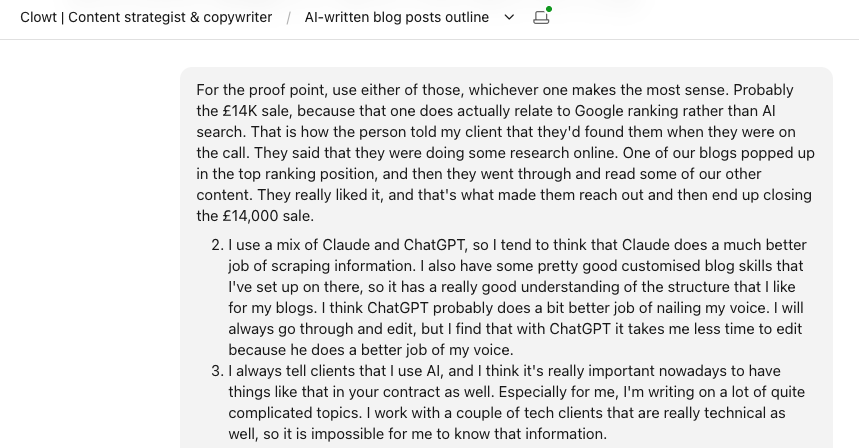
Blogs can bring in actual paying clients, too. One of our clients closed a £14,000 sale that started with a blog post. The buyer had been doing some research online, found one of our articles in the top spot on Google, read more of the client's content and got in touch.
I'm not suggesting you can publish one blog and have fourteen grand turn up in your bank account by Friday. But good content keeps introducing the right people to your business long after you've hit publish, which is why I'm so bloody passionate about this stuff.
Do AI humaniser tools actually work?
Personally, I wouldn't bother, and I certainly wouldn't pay for one.
AI humanisers promise to rewrite AI-generated content so it sounds more natural, and some claim they'll get your text past AI detectors. Which sounds lovely, except they're still just rewriting the text you gave them. They can't add a client conversation you never shared, and they definitely can't give your article ten years of experience in your industry. You end up with the same generic advice rearranged, sometimes in words that sound considerably weirder than the original. George Kao points to independent testing of 16 humanisers where only 2 actually worked.
Will Google penalise AI-written blog posts?
Google's guidance on AI-generated content says using AI isn't automatically against its rules. What matters is whether the content is useful, accurate and original, and made to help readers rather than manipulate rankings. Using AI to research a topic, organise your ideas or help write a draft is fine. Using it to mass-produce low-value content purely to chase rankings is where you run into problems.
Lazy SEO was always crap. AI's just made it much easier to do at scale. So ask whether you've published something worth reading, however many of the words AI helped with.
Frequently asked questions about writing blogs with AI
How do you write with AI without sounding like AI?
Start with your own opinions, experiences and examples before asking AI to write. Record a voice note, build a clear outline and give the tool examples of your natural writing style. Ask it to draft individual sections, then edit the finished article for substance as well as tone. If the ideas are generic, changing a few words won't fix them.
Can I use AI to write my blog posts?
Yes. Google doesn't automatically penalise AI-assisted blog posts. AI is useful for research, outlining, drafting and editing, provided you review the information and add genuine value. What matters is that the article answers the reader's questions and offers something beyond what everyone else has already published.
Which AI doesn't sound like AI?
None of them consistently, straight out of the box, and what you give it matters far more than which one you pick. I use both: Claude for research and structure (I've set it up with my own blog-writing instructions), and ChatGPT because it usually gets closer to my natural style, so there's less editing. Neither publishes anything without me checking it first.
How do you prompt ChatGPT to not sound like AI?
Stop asking it to "sound more human" and give it something to work with: your transcript, an approved outline, writing examples and clear rules about what it can and can't invent. Ask it to keep your phrasing, avoid repetitive AI patterns and flag missing information instead of making things up. Source material gets you much further than a 3,000-word prompt telling ChatGPT to be witty, relatable and authentic.
Should you tell readers when you've used AI to write a blog?
Google encourages giving context about how content was made when that would help readers. With clients, I'm much firmer: yes, absolutely. Every client I work with knows I use AI, and it's written into my contract.
I write for some properly technical businesses, and AI has massively cut the time it takes me to research complicated subjects and make sense of unfamiliar terminology. But it isn't always right, so my contracts also make clients responsible for checking technical accuracy. They're the experts in their field, and I'm not going to pretend I know more about their industry than they do because I've spent an afternoon chatting to Claude.
Want AI-assisted blogs that sound like you, without writing them yourself?
I'm obviously a big fan of AI. I use it every day. But we've ended up in a slightly ridiculous situation where business owners spend more time trying to make AI sound like them than they would have spent writing the bloody thing. When you've got a business to run, that's hardly ideal.
So at Clowt, we plan your topics around what your audience is searching for and what your business actually needs, then handle the research, structure, writing and optimisation. You bring the expertise. Sometimes that's a voice note, sometimes it's a comment on a draft, and sometimes we need to pick your brain before we start writing. Either way, nobody's expecting you to sit down and write 2,000 words every week.
You stay the voice and we do the work, so you get blogs that sound like you on your sharpest day, with a proper SEO strategy behind them.
Featured posts